
Hooray, found the receipt where I purchased the map I was referring to.
I am off to Mom's and tomorrow or very late tonight will continue my pursuit of finding the map.
Jean J

I checked a lot of photos of dog tags and identity cards of prisoners of war in german camps, nearly all numbers are below 20,000, and all of them also name the camp, as we see it on your (Jean's) dad's letters. I found a german forum where this question is also discussed and all panelists agree that the numbers were given in the camp, unique only for the camp. Sometimes numbers were already given in a FRONTSTALAG near the front or a DULAG, but it seems as if the prisoners were normally not numbered before reaching the STALAG. On the POW identity card it looks as if they got the card quickly after beeing caught, but the numbers were filled in later.
Christoph
Wow, Christoph, your messages always take a lot of time to digest!
The logic you propose on the numbering scheme makes sense. I was just thinking because Siegburg was a Hospital that they kept track of how many got sent there - but that would be too complicated to track and know that some had been moved out of the Hospital so there was room for more. I could keep coming up with lots of combinations of what ifs, and then Siegburg could have been unique in how it was handled anyway.
One way for me to get more info is for Mr. Norton to request his records and see if there is a POW # there. But may not be a POW # on whatever records exist. My Dad was conscious of his number and used it in later paperwork.
But I am optimistic - remember the After Action Report on the liberating of Waldprol - I have the name of the lady who typed them up for the 309th Infantry Regiment. Now since she did this in 2004 who knows what her condition is or what was her connection to want to do that labor of love. I left a message on a telephone answering machine over a week ago and said I would call back. I said that I wanted to thank her for preserving the information and making it so available.
I am going to post cause machine just acted funny.
JJ
So back to the numbering scheme. It would make sense if a Camp had say a range of numbers like 13,000 to 14,000 that they could use. But those early men you found were # 11,000 and I can not imagine that they had over 2,000 more POW's that early on get taken all the way to Siegburg. But, ...
Will be interesting to see numbers of other prisoners in other Camps. I wonder if that AF gentleman that was in the plane with Dryden would know his number. And also a Medic's story that I unearthed and talked to the gentleman in Massachusetts. Actually I know some other Ex POW's and could pursue this numbering system at some future time and maybe get lucky so we could figure it out. I will put it in my "To Do" list.
Now back to the 309th Regiment - I had planned to ask the lady I was calling about the AAR (After Action Reports) if there was a central source or person where I could put in a request to learn more about the liberators and the Medical Detachment and their reports. Maybe I could really get lucky and someone would be alive. So that too is on my list.
However, last night at Mom's, the Care Giver, who knows of my WW2 interests showed me a book she had that was from 1944 -1945 and was printed by Eukerdruck K.-G. Marburg (Lahn), Germany. It was kind of like an address book (no stories on what they did during the War) on the 309th Regiment, Men of Diehard, and John H. Ondrick was the Col, Inf. Cmd. in the Care Givers past, she knew some families that were part of this outift. Pretty strange! So I will pursue this desire to learn more about the Waldbrol liberators through that source as well.
More to follow,
Jean J
Now last but not least, as the expression goes, the disc with the Jan. 1945 Siegburg map has been located. Steve just printed it again, and I see the problem, as I think you will, that I need more North and West information.
Steve is setting it up so you can click the address to access the map.
I will send the address as soon as I get it.
Christoph, as always, Thank You so much for trying to solve all of the puzzles!!!
Jean J
I signed off too soon because he just sent this to me:
They can download the map here:
www.jjworld.com/images/germany_seigburg_sheet_5209.jpg
It is pretty incredible all of the detail!
And Dad had to cross the Sieg.
Jean J

What a great map! Thanks for sharing that.
Marion J Chard
Proud Daughter of Walter 'Monday' Poniedzialek
540th Combat Engineer - H&S Company
Wow! Some years ago I bought a CD-ROM with historical maps of Siegburg and have placed them this evening here to look for such a map - but you've been faster. On the CD are maps of 1817, ...,1938 and 1948, but not this of 1945. They show exactly the same area and are also # 5209.
But I have some other older maps: the next one in the west Bonn (#5208) and in the north Lohmar/Wahlscheid (5109). Maybe some houses are missing, but the times were not running so fast then and the differences to 1945 shouldn't be too big.
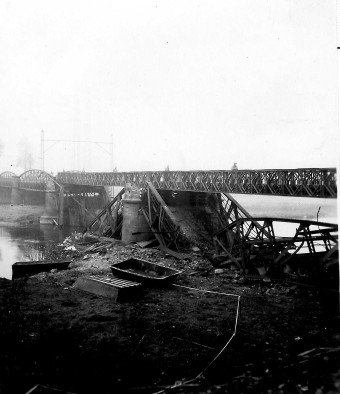
When your father crossed the Sieg already in March, the bridges might still have been usable. If not, there are some fordable places, the Sieg is not so wide. Later nearly all bridges here were blown like the one to Mülldorf below which was recovered with a bailey bridge by the 1262nd Engineer Combat Battalion after the war.
Christoph
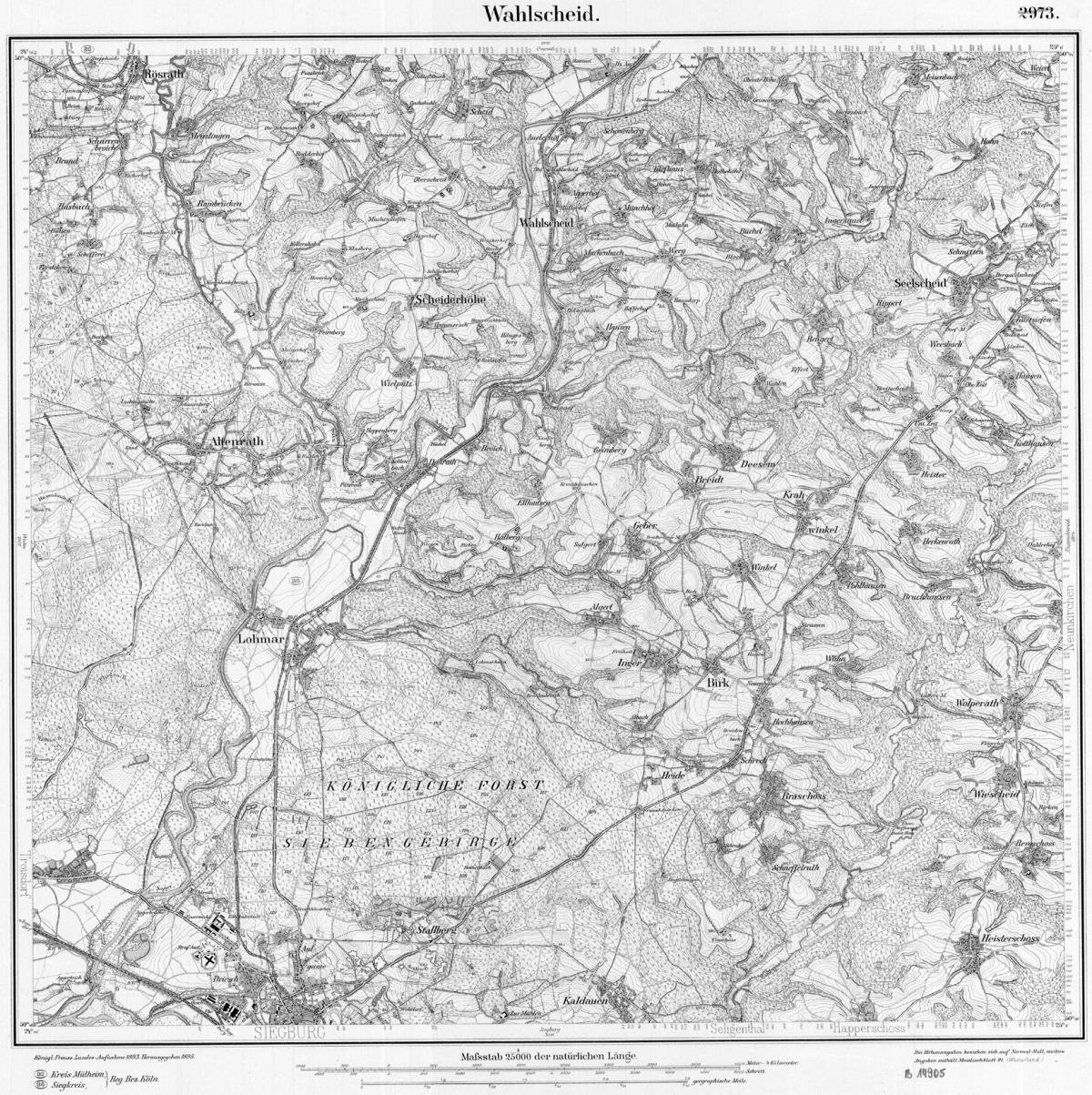
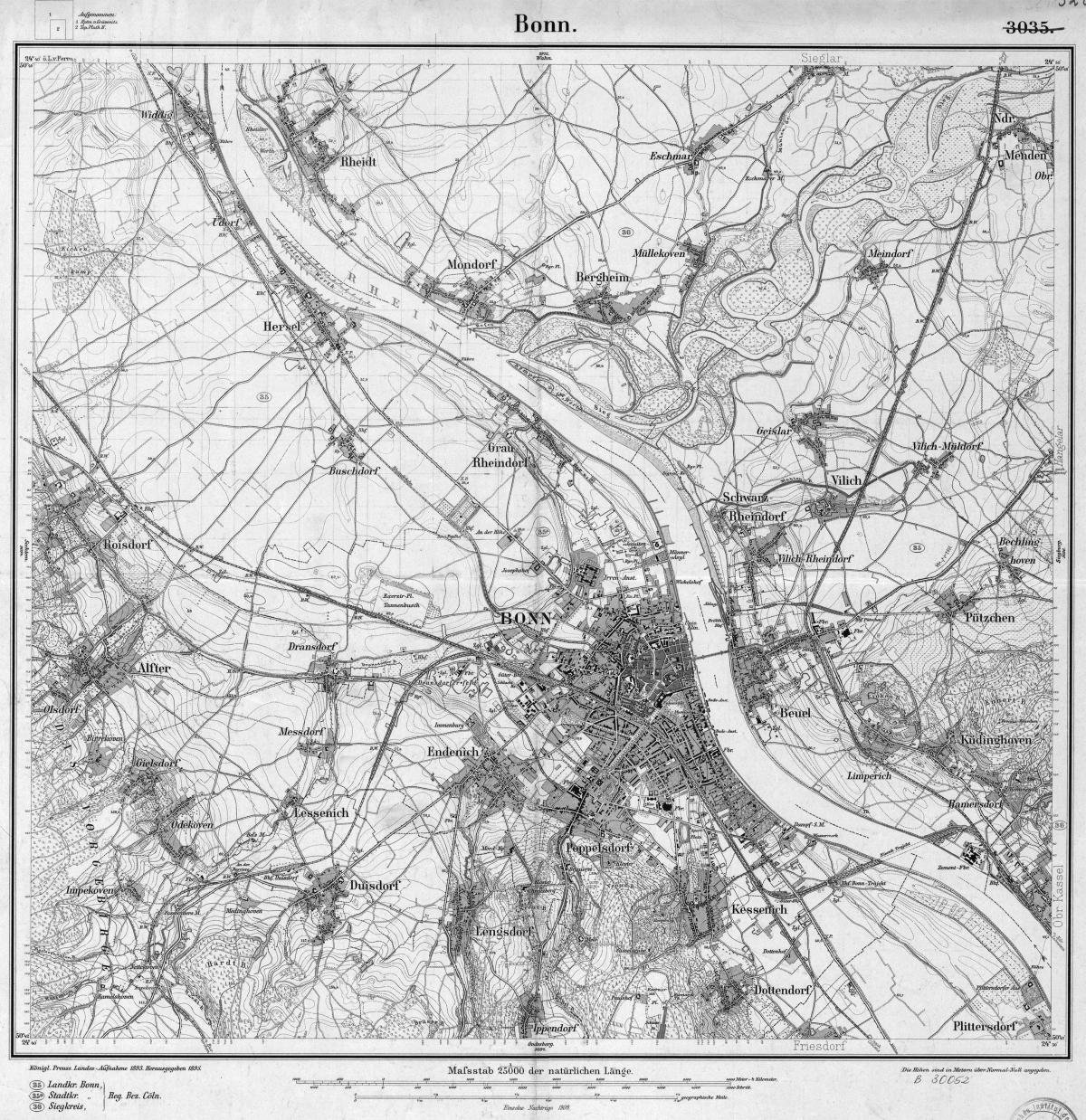
Christoph and Marion,
Glad the map I had looked good to you both. I could not really benefit much from it when I got it, and filed it away. I recall it took a long time to get it and my research took me to a University that had the Map because they also had the War records on I believe it was Patton. I now have it in the queue to see if I can locate the purchase details - phone numbers etc. and then see what they have and if I can order the discs for the maps of areas next to the one above.
Christoph, thank you for attaching those maps. Steve asked if it was possible to get full image files of what you attached. He can not enlarge or print from a thumbnail. He said we can print (17 x 22 inch paper) the full image file and then mail them to you or bring them to you when we come this Fall.
I will be pretty busy the next 2 days but do have a couple of things to share and will try to jot them down later. Bye for the moment,
Jean J
Hello!
Finally, one of the items I wanted to share with you was that in one of the letters from Dad to my Mom (that has the top part missing where he would have written the date), Dad writes "I have my P.W. number now - 13012 so be sure to use it on any letters you write."
It does not sound like he has just arrived but it appears it is early on in his time at the Michaelsburg Abbey.
Bye for the moment,
Jean J
Christoph I have a question. I am trying to organize my piles of papers and I am looking at the Red Cross Map that my Mom got back in 1945. With my new knowledge that Lazarett means hospital, I do not think the Lazarett 6G on that map is our Siegburg/Michaelsburg Abbey?
If I go back and try to figure out on which entry I sent that map, I am afraid I will lose this message.
I also want to go back and look at the cousin's map. I know I have not sent it yet.
No one at the Univ. of Illinois has returned my call where I have requested information on additional maps that I can order like the Siegburg one. Maybe they are on holiday. I will try again at some point.
Jean J
These are the photos from the Air Force Academy in Colorado that Steve's cousin sent us. Steve has put them on the server and here are the links.
www.jjworld.com/images/PrisonCamp.jpg
www.jjworld.com/images/RedCrossMap.jpg
Once again the Siegburg/Michaelsburg Abbey is not there?
Jean J
Jean
Yes, a Lazarett is a small military hospital. Civil and bigger military hosptals are called "Krankenhaus" - so the Bethesda Naval Hospital, also well known in Germany from NCIS and other TV series, is not a Lazarett.
And no, Siegburg is not on the map, and there are hundreds of camps and hospitals missing.As I have written somewhere above there were hundreds of inferior camps, work commandos to each main camp. The hospital on the Michaelsberg in Siegburg was such an inferior hospital for sure as there was only a small area in the abbey for the prisoners, the main area was reserved for german soldiers.
The prison camp picture is interesting, but I'm afraid better to allay than to inform the soldiers.
We got so much material and information, and with every answer two new questions...
Christoph
Quick note, I contacted this amazing gal, Sue, whose Dad was with the 309th Regiment.
She is the one who personally keyed in the After Action Reports for the 309th. What a great service to humanity and for the history of the War.
She sent me some interesting things and more to follow tomorrow.
Jean J
Now where to begin and as always so little time.
The Univ. of Ill. gentleman, Dan, (site with the maps) had left a telephone message for me and I finally happened to listen to messages. I talked to him today and he was so helpful and supportive. Next week he will look at the Bonn map and the other maps he has and see how they connect up to the Siegburg one I sent you all. I doubt Dad went East when he escaped. His sense of direction was not his best sense, but he had Gidrie who surely had a better sense of direction and most importantly they could look down from the Abbey and get some idea of which way to at least start running.
Dad knew how to swim (he had been a life guard for several summers in NY) if that was required getting over the Sieg River. I do not know about Gidrie and his swimming expertise. I do not know the depth of that River or the current, again, if that was the only way to get to the Rhine.
Dan also said he would check their records to see if perchance Dad ran into the outfits whose records they hold. So unlikely, but one never knows - look at this website and the Diary on Walter - that was truly unusual!! And finding Christoph was off the charts!!
Now the other piece of news that I was so anxious to share - Sue, the devoted daughter to the 309th Regiment and the men, communicated with lots of members. She has a letter from June of 2002 from a 309th gentleman and he tells about a battle on Hill 305 where he and others were wounded. He talks about the German Aid Station and then the First Field Station both taking very good care of them. And then he says it - they were taken to Waldbrol! So these guys were part of the 71 that were liberated from Waldbrol. This man according to Sue has been deceased a couple of years and in 2002 he says that 2 of the other gentlemen were now deceased.
There are a couple of additional names that I will see if Sue, when she has a chance, could see if they were still alive and healthy enough or willing to share their Waldbrol experiences. Who knows if they would know when the Siegburg boys came there or anything about them. But would be great to hear anything about Waldbrol!
More to share, but have no definite news on it, so will sign off for tonight.
Jean J


