
Seabee History: Formation of the Seabees and World War II
http://www.history.navy.mil/faqs/faq67-3.htm
Marion J Chard
Proud Daughter of Walter 'Monday' Poniedzialek
540th Combat Engineer - H&S Company

Seabee History: Formation of the Seabees and World War II
WHAT IS A SEABEE
Between a Soldier and a Marine there stands an individual called a SEABEE.
SEABEES come in assorted sizes, shapes and weights, but all have the same code: Enjoy every second of every hour of every day, whether at work or at play, and to protest by griping (their MOST treasured privilege) when issued an order.
SEABEES are found everywhere: on top of, underneath, inside of, climbing on, swinging from, running around or more likely than not…turning to.
Mothers and sweethearts love them. Airdales and Fleet sailors hate them, Company Commanders tolerate them and Chief Petty Officers drive them.
A SEABEE is a composite, he has the appetite of a horse, digestion of a sword swallower, the energy of a mini H-bomb, the curiosity of a big cat, the lungs of a dictator, the imagination of Paul Bunyan, the slyness of a fox, the enthusiasm of a fire cracker and the spirit of a fighting ****. He likes: liberty, leave, holidays, weekends, women, chow, BEER, movies, geedunks, swimming, pin-ups, sleep and comic books.
A SEABEE isn't too thrilled about: Duty nights, watches, taps, reveille, routine discipline, officers, drills, marching or secured heads.
Nobody else is so early to rise without actually wanting to get up. No other person gets so much fun out of Liberty or Shore Patrol. No one can have so much fun on so little money or time.
A SEABEE is a magical creature: you can chew him out, but you can't get the work done without him; he is dirty, unpolished, not squared away, often overbearing and sometimes reluctant.
A SEABEE is a person of magical abilities: he can weld, build, drive, repair and fight all at the same time; he can destroy or he can beautify, instantly; he can make something out of nothing; work never tires him, nor does he seem to tire of it!
His motto is "CAN DO", to which he adds "HAS DONE" and "DID", these frequently impossible feats are recognized in the form of a "WELL DONE" by everyone from the Commanding Officer on down.
The average SEABEE is a thick-headed individual of a variety of nationalities. They won't admit to anyone or anywhere, except in the defense of their Battalion that they have the BEST job in the Navy. Without them, the Fleet would have nothing to talk about. Marines would have nothing to gripe about and History would have nothing to write about.
GOD BLESS THE SEABEES
Captain Wilfred L. Painter (CEC, USNR), was truly a legend in Seabee history. A movie could be made of his exploits. Much of his work in the Pacific had been confidential, almost nothing was written about him.
Author William Bradford Huie, in his book From "Omaha to Okinawa" wrote a few pages about him. I have condensed some of Huie's writing.
If Painter had lived in the 16th Century, he would have been Captain Blood, if in the 19th, he would have been a mixture of Jeb Stuart, Buffalo Bill, and Jesse James.
After Guadalcanal, Painter became one of the Navy's advance Scouts in the Pacific. It was his job to pick landing sites, and particularly to pick the sites for airfields to support our operations. On every island in the Solomons on which we landed, Painter was there before the landing - surveying, taking soundings, determining whether and how fast an airfield could be built there. He had sneaked ashore from Submarines and PT boats, hidden in caves, dodged Japs, ambushed Japs, made rendezvous with his subs and PT's, and returned with the information on which the decisions were made.
Painter is an engineer. To understand the importance of his work, you must understand the importance of his work, you must understand the importance of engineering to the war's naval operations. Every landing we made in the Pacific was made with one prinipal aim in view: to obtain an airfield. If the Japanese had an airfield on the island, was it on the best site? could the Jpanese field be lengthened and enlarged for our use? If not, where was such a site? What about prevailing wind direction and its relation to proposed runways? Was there a coral deposit nearby? If not, what would be used for building material on the runways? What about supplying the airfield? Was there deep water nearby in which piers could be built and Liberty ships docked?
Some of our line admirals were slow in realizing their dependence on those engineering considerations, but Painter, with his brusque but efficient manner, was there to advise them. Admiral Halsey, no shrinking violet himself, quickly recognized Painters value, and Painter became a captain at thirty-five the youngest four striper in the Navy.
On Pearl Harbor Day he was building a dry dock at Long Beach. He was rushed to Pearl Harbor and placed in charge of raising the battleships California and West Virginia. He worked like a fiend. He dived with divers, and was so covered with scum each night that he had to bathe in Kerosene. A doctor was assigned to follow him throughout the dark, muddy bowels of the big ships to revive him when he collapsed from sulphur dioxide gas. He had both ships raised and in dry dock before anybody believed it was possible.
The earliest Seabees had been rushed to Efate and Espiritu Santo, and they completed an emergency airstrip at Santo - our first jump off base - just ten days before D-Day at Guadalcanal. Painter was in this area as engineering officer on the staff of Vice Admiral McCain, commander of naval aircraft in the South Pacific. In effect, he became all around engineering handy man for Admirals McCain, Turner, and Halsey throughout the South Pacific campaign, In effect, many of the engineering decisions, were Painters, as evidenced by the fact that he was jumped from Lieutenent, to Lieutenent Commander, to Commander, and then to Captain in rapid order. He was thirty five when he put on his four stripes.
Rank meant nothing to Painter, however. Like most of the Seabee officers, he was essentially a civilian, and wanted only to get the job done and get out. He hates red tape, and his adventures in cutting it are Pacific legends. He would tell off an Admiral as quickly as he would a seaman second-class, and only his sheer ability as recognized by broad-guaged men like Admirals Moreell, Halsey, and Nimitz kept him from being canned.
Painter tore around the South Pacific on all sorts of missions. Two days after the Marines had taken Henderson Field, he landed there in Admiral McCain's flag plane and began surveying sites for fighter strips Nos. 1&2. The Japs came over, Painters plane had to run off and he was left on Guadalcanal. When the old destroyer Mcfarland was hit, Painter patched her up and saved her. When we were ready to move northward "up the slot" Painter was sent to New Georgia to pick the landing and airfield sites. He sneaked ashore there and found a British colonial official who was hiding from the Japs with a small party of natives.
The Britisher provided Painter with a canoe, a guide, and some bearers, and the party started on the water trip across Viro Harbor, which was held by the Japanese. A storm almost swamped the canoe before it could reach shore. Painter spent the night in a cave. Next day, as the wind became even stronger, he abandoned the canoe and set out to explore all the land around Viro Harbor by foot. With his native guides, he waded swamp for two days, traversed thirty miles, and concluded that a landing was not feasible at Viro. There was no site where an airfield could be built quickly. Painter left the Viro area, went to Segi Point, and found the spot he was looking for. Disguised as a native and in a captured Jap landing craft, Painter took soundings off Segi in full view of Jap land parties. Later Painter returned to Segi with a survey party and actually began work on the airstrip. The 47th Seabee Battalion landed there on June 30, 1943, D-Day in the Munda operation - and completed the airfield in ten days.
This was only the beginning of Painters scouting experiences. He dressed like Davey Crockett. He flew thousands of miles, traveled in PT's and subs. He was fired on by Japs and Americans alike. He was on Northern Luzon looking for airfield sites long before the Japanese realized that they had last the Philippines. He has been other places, too, but the full story will have to wait.
The Fighting Seabee
The Navy needed fighters
And they needed engineers,
So they organized the Seabees to
pin back Nippee's ears,
They took welders, riggers, boilermen,
cooks and bakers too;
They signed them in the Navy, which
was the thing to do.
With Tommy guns and rifle, we Seabees
learned to shoot;
We used a big machete knife, and other
things to boot.
They taught us how to march and drill,
They taught us how to dress;
We learned Commando tactics and
we bucked the line at mess.
We learned the Navy lingo; we called it
"deck" and "swab";
We learned just how to "knock it off"
like any other gob.
They taught us all these many things
in thirteen weeks or less,
And what they didn't teach us, the rest
we had to guess.
We finished out our training and
we sailed to Island X,
We had all our equipment stowed
below and on the decks.
The japs they held the island when
at last it hove in sight;
We knew that they were ready, so we got
prepared to fight.
We landed under heavy fire, and
there was plenty hell,
It kept us busy most the day, just
dodging every shell.
We soon had wiped the Nippees out
and then we went to work,
Each Seabee did his duty - not a one
was seen to shirk.
We built a mighty landing field,
a barracks and a dock,
About a hundred miles of road we made
from solid rock.
We got things finally squared away,
'twas pretty to be seen,
Then we went back to the beachhead,
where we saw our first Marines.
They had followed in behind us,
though they said they got there first;
We had everything completely fixed,
they could even quench their thirst.
From the Halls of Montezuma, to the
shores of Tripoli
It used to be the Leathernecks, now
it's all Seabees.
And when we reach the Pearly Gates and
stand at Heaven's scene,
There'll be a Seabee waiting there
to greet the first Marine.
THREE super, super posts.  The Seabee poems were top-notch and the story of Painter was outstanding. I could picture him doing all this and imagined a movie. What a movie that would make!
Marion J Chard
Proud Daughter of Walter 'Monday' Poniedzialek
540th Combat Engineer - H&S Company

John Wayne.....' The Fighting Seebees ' ?
A Moose no longer alone in the Wolverine State.
UNBELIEVABLE CONTRIBUTION
We of the Marine Corps know firshand, perhaps better than anyone else, the almost unbelievable contribution that the Seabees have made to victory. Many times we have fought side by side in the early stages of battle, before there was room for you to proceed with your assigned construction projects. While we pressed farther inland, you laid aside your arms-but not too far away to pick up your working tools and build highways, airports, supply depots and innumerable other projects, It was a comforting thought to know as we pushed the enemy back that you were right behind us with your bulldozers and your tractors, year graders and your power shovels guaranteeing us roads to bring up our supplies and ammunition, and to return our wounded, and airports for our planes to use in supporting our troops and in pushing the attack.
During the interludes between operations, fortunate indeed was the unit that was located near a Construction Battalion. Then, the more peaceful pursuits of erecting a flagpole, repairing a watch, were childs play at the hands of the Seabees. The Marines who have fought together with you against the Jap will never forget the support you have given us unfailingly from Guadalcanal to Tokyo. The bend of fellowship between Marines and Seabees, forged by the heat of battle, is one which I am sure will last as long as there are veterans of these organizations left to recount firsthand experiences of the many hard-won battles of the war.
On behalf of all Marines in the Pacific, I want to extend my Thank You, and Well Done!
ROY S. GEIGER
Lieutenant General, U.S.M.C.,
Commanding General, Fleet Marine Force, Pacific
A great tribute to the Seabees from ROY S. GEIGER, Lieutenant General, U.S.M.C., Commanding General, Fleet Marine Force, Pacific! Here, here! 

Marion J Chard
Proud Daughter of Walter 'Monday' Poniedzialek
540th Combat Engineer - H&S Company
A great tribute to the Seabees from ROY S. GEIGER, Lieutenant General, U.S.M.C., Commanding General, Fleet Marine Force, Pacific! Here, here!
"NEVER LET US DOWN"
As the former Commanding General of the Fifth Amphibious Corps and Commanding General Fleet Marine Force, Pacific, it gives me great pleasure to send a brief message to the bi-weekly magazine SEABEE for their final and souvenir edition.
In my humble opinion the formation of the Seabees was one of the finest developments of this last war. The outstanding work of the Seabees and their magnificent courage in battle played a most important in the successful prosecution of the war.
It was not an unusual sight to witness the Seabees performing their duties under heavy fire. It was an inspiring sight, for instance to see them working one end of the airfield while the Marines were fighting on the other end. They were equally at home with the tools of their profession or with the weapons with which they were armed. The spirit of brotherhood existing between the Marines and the Seabees was forged in the holocaust of battle. Perhaps I can sum up this brief message in these few words. "THE SEABEES NEVER LET US DOWN".
With sincere personal regards,
H.M. Smith
Lieutenant General
U.S. Marine Corps
We work like hell, we fight like hell,
And always come back for more:
The Navy's advance base engineers
On many a foreign shore.
On half the lousy islands
For here to Timbucto,
You'll find a hive of Seabees-
One hell of a fighting crew.
The admiral just dropped around
To chat the other night,
He said, "Now boys, I know you work
But you've also been trained to fight.
"So if there's any trouble, don't stop
To put on your jeans;
Just drop your tools, grab up your guns
And protect those poor marines."
Marine friend sent this!
I often find myself wondering, who are they; when I hear the phrase "Unsung Hero's?" A hero is defined as: with courage, nobility, and one who fears no danger. Sixty-three years ago when I was age nineteen I met a group of people; some who were almost twice my age. I met them on a battlefield, on the island of Tinian, some eight thousand miles from our west coast They carried only small arms weapons while building the largest airfield in the world, that brought an ending to World War 2. Some history books have their deeds too deeply imbedded in the books back pages. Marines place their deeds much closer to the front pages.
As a former World War 2 Marine Sergeant, I now realize when "War" holidays approach us, we are often reminded of deeds we didn't give much thought to, heroic acts we had to put on hold. These holidays have a way of making us remember those among us, who were the "Unsung Hero's" of the pacific, as we hop-scotched every island, on our way to victory over Japan.
After sixty-two years, and my memory flashbacks of world war 2 courage, I'm still reminded of the warier with the "can do" the job attitude, tirelessness, and most of all; many times, being side by side with we the Marines, mopping up every foxhole and cave, until they were declared secure.
If I were to continue writing it would take many pages to fully cover why this Marine, and all Marines are thankful that our government ordered our defense department to organize a much needed "Navy" construction force to aid our Marine Corps. It was then that skilled construction workers, patriotic "Older" men (average age 37) volunteered to answer the call. They needed little advanced training; they quickly excelled in small arms weapons training, and Navy discipline. The rest is history.
Did I make you wait too long, or does my message assure you: "We, The Proud Marines" during World War 2 give thanks to our new found, and tireless comrades, "their" huge airfield on Tinian gave so many of us the thrill of coming home "alive" to our loved ones. Yes, the memories do come back. We now offer a strong firm handclasp to our best friends; the United States Navy Seabees. They are truly Americas "Unsung Hero's."
Sgt. Dick Beard; USMC 1943-1945
Richard L. Beard
On 5 May, 1945, Roy E. Ellett, CM2c, and Quentin A. Carroll, MM2c, (130th NCB) did perform meritorious service in connection with military operations against the enemy on Okinawa Shima, Ryukyu Islands. Serious fires were blazing in native structures adjacent to an important supply road. One burning structure collapsed on the road, halting traffic and endangering personnel and military vehicles. Ellet, without considering his own personal safety, drove his bulldozer into the flaming structure. Despite the intense heat and choking smoke, he cleared the burning debris from the road, permitting military traffic to flow again. A strong breeze threatened to set afire an entire block of buildings at an intersection of the "utmost importance" Despite the intense heat blown into his face, Carrol, without hesitation and disregarding his own personal safety, drove his bulldozer up over an embankment, pushing flaming buildings back to a safe distance and smothering the burning debris with dirt. Due to his outstanding service, MM2 Carrol made it possible for the flow of military traffic to be resumed. So reads the recommendation for the Bronze Star medal signed and attested to by 1st Lt. Leon T. Struble, and USMC Sgt. Warren E. Brenfman, Headquarters, 1st Engineer Battalion, who witnessed the incident and heaped high praise on both Ellet and Carroll. During those first two weeks in May, the battle for the Shuri defense zone had reached a deadlock with the Japs holding the 1st and 6th Marine Divisions on their left, the Army's 77th Division on their center and the 96th and 7th Army Divisions on their right. Two strongly defended points, Chocolate Drop Hill and Connical Hill, had to be taken, in order to encircle Shuri and trap a portion of Jap General Ushijimas forces. It was during this critical stage that the construction and maintenance of roads solved the problem of supply for the five fighting divisions. Carroll and Ellett, heavy equipment operators went beyond the call of duty to uphold the Seabee tradition "Can-Do".
--------------------------------------------------------------------------------
A big CAN-DO!
Marion J Chard
Proud Daughter of Walter 'Monday' Poniedzialek
540th Combat Engineer - H&S Company

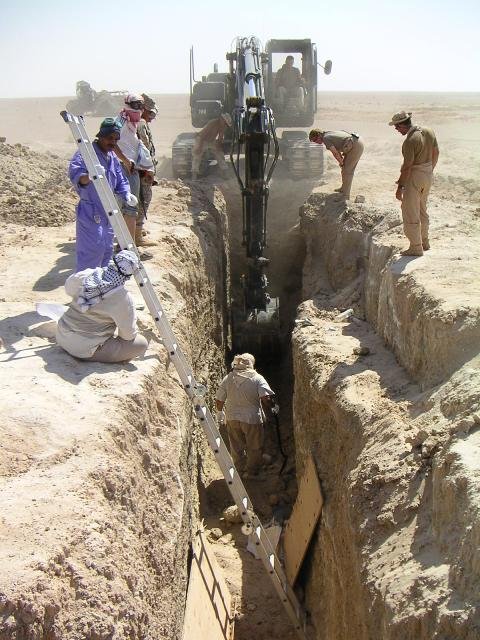
I dug the poem (even as a Marine!) My experience with SeaBees has been limited to a brief time with them in Iraq. My platoon was assigned the task of security for the digging up of a Kuwaiti mass grave in Iraq. We actually did it twice; there were about 50 bodies in pits at each site. The CB's used heavy earth movers to do the digging. They were awesome! The main excavator operator did it in his civilian job (he was in the reserves) and he moved it like he was an extension of his body. He and the rest knew their stuff.
Maj Todd O. USMC, Retired
Grandson of LTC John O'Brien
I dug the poem (even as a Marine!) My experience with SeaBees has been limited to a brief time with them in Iraq. My platoon was assigned the task of security for the digging up of a Kuwaiti mass grave in Iraq. We actually did it twice; there were about 50 bodies in pits at each site. The CB's used heavy earth movers to do the digging. They were awesome! The main excavator operator did it in his civilian job (he was in the reserves) and he moved it like he was an extension of his body. He and the rest knew their stuff.
The practice of "absorbing" Seabee units into Marine units was commonplace in the Pacific, with one result being high casualty rates and another being under-reporting of their contributions to the cause, at places like Guadalcanal, Tarawa,Saipan, Peliliu, and Iwo Jima. Not many know, that besides Corpsmen, many Seabess also wore the USMC uniform.
