
Folks, Gary is real good at this isn't he? I'd say that's a definite match
Randy
Following the vote of approval from our 292nd leader, Randy, here is yet another update to the A Company photo! 
Gary
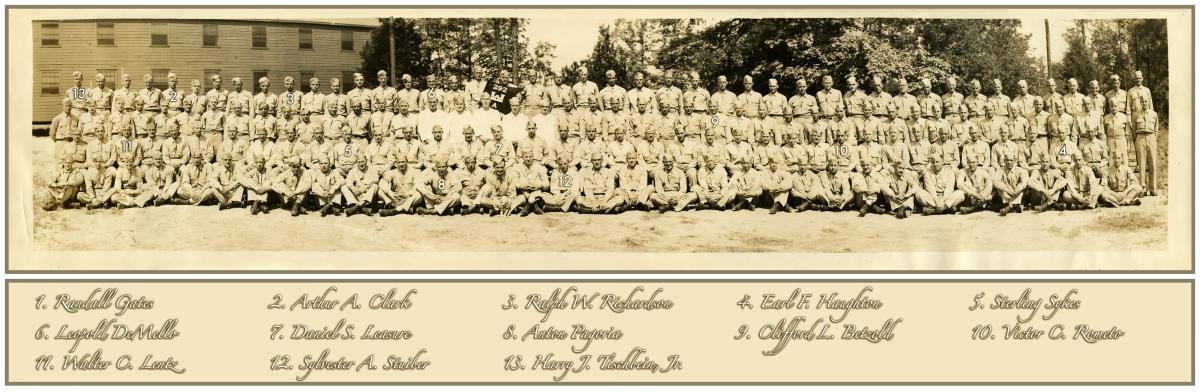
Gary L. Gates
Proud Grandson of Randall Gates
Mechanic, A and H&S Companies, 292nd Engineer Combat Battalion, 1149th Engineer Combat Group
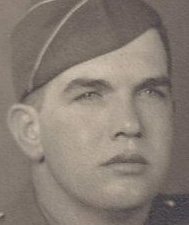
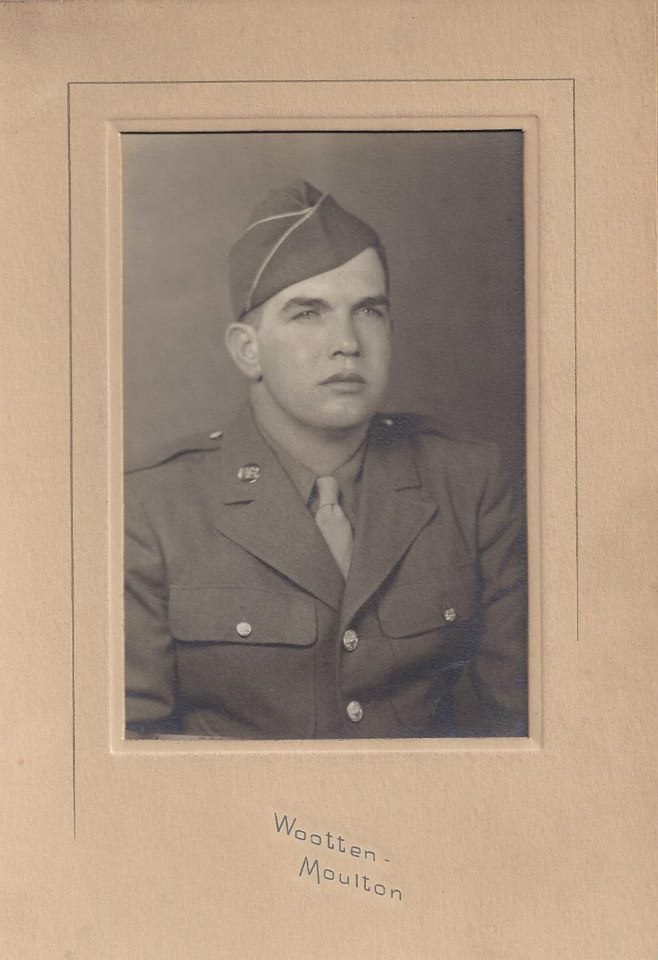
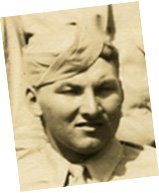
Here's yet another one, folks. This is Arthur A. Rennels SN 35 813 469 in a photo of a portrait photo from his "Find-a-Grave" page and the guy I think may be him from the A Company photo. This one is a little more of a question. Keep in mind a few things, however. The right eyebrow with it's distinctive wave motion is spot on in both. The line right of his nose is also there in the portrait (less distinctive because he is not squinting in bright light as in the company photo). Also, if you look very closely at the ridge in his chin in the company photo and then at the portrait you will find it there also just a bit less dramatic because of the soft studio light. The right ear is identical with the lobe being attached the same way. Just remember when considering all of this that in the A Company photo his face is clenched since he is looking into the sun whereas in the portrait his face is relaxed. What are your thoughts?
Gary L. Gates
Proud Grandson of Randall Gates
Mechanic, A and H&S Companies, 292nd Engineer Combat Battalion, 1149th Engineer Combat Group

Gary,
I think you've got a very strong match with Steiber.
I don't think I'm with y'all on the KP theory. Everyone else is dressed for the photo. If the KP guys stayed in their whites, you'd think everyone else would be in fatigues. When you say "medical detachment," are you talking about medics? They'd be with the unit, but I don't think they'd be in white, would they? And why would they be placed so prominently? It's definitely an interesting little problem. Too bad we can't see insignia on more of these guys.
I did give a copy of the Company A photo to the Camp Butner Society. I definitely want to get them some names, but you're adding so many names every day that I think I'll wait a while. Right now, they don't have a place to display it anyway. The museum is just a small room currently, and they told me they have quite a bit in storage. Based on what I've seen on their Facebook page versus what was in the museum, I'd have to confirm that.
Randy,
The original Company A photo is also lightly brown, almost sepia. It's too even to be aging, in my opinion, so I think the light brown is original. Looks good with the khaki in the uniforms. Just my opinion.
Lisa
Lisa,
I think I'm following what your trying to say, that the men in white are "out of uniform" or at a different level of dress than the all rest. If all the other soldiers were in their Class A (formal) uniforms, your observation would be absolutely correct, the men in white would be in a lower state of dress. I do not believe that is the case here, the Khaki (semi-formal) uniform is in between the everyday fatigues and the formal dress Class A uniform. You are correct that medics don't wear white, they wear the same uniform as everyone else. They do wear the white arm bands with the red cross during field exercises or in the combat zone to display their position. The men in white are not wearing any officers insignia, which pretty much rules them out as being doctors or dentists, such men would be officers. Officers would not be seen without wearing their rank (with the possible exception being in the combat zone, as to not make an inviting target for an enemy sniper). These men in white are privates, which I think helps to make the KP theory. In the end the answer could be something altogether different than the KP or the medical personnel ideas, something we are not thinking of. Perhaps if one of these men in white could be positively identified it might provide the clue that answers the mystery.
Randy
"The Damned Engineers!" <img alt=":banghead:" src="/uploads/emoticons/default_BangHead.gif" />
Recently, Randy posted the ship's name that the 292nd had shipped home on, the SS Hampden Sydney Victory. I ran across some manifest documents from that trip which began on Feb 21, 1946 in Le Havre, France and ended in New York Harbor on March 2, 1946. Unfortunately, there were no unit documents with passengers from the units that came home on that trip (some ships had unit lists like this).
These are all the documents that I have found from the trip.
Gary
Gary,
This is a very nice find my friend, thanks for posting it, interesting! It is my understanding that Uncle Sam intentionally destroyed (God knows why!) all the troopship manifest lists, I think sometime in the 1950's. However lists from some ships may have survived for one reason or another. My grandfather's discharge paper shows him returning stateside at this time, so I'm confident he was on this ship. Have a good one.
Randy
"The Damned Engineers!" <img alt=":banghead:" src="/uploads/emoticons/default_BangHead.gif" />
Lisa,
I think I'm following what your trying to say, that the men in white are "out of uniform" or at a different level of dress than the all rest. If all the other soldiers were in their Class A (formal) uniforms, your observation would be absolutely correct, the men in white would be in a lower state of dress. I do not believe that is the case here, the Khaki (semi-formal) uniform is in between the everyday fatigues and the formal dress Class A uniform. You are correct that medics don't wear white, they wear the same uniform as everyone else. They do wear the white arm bands with the red cross during field exercises or in the combat zone to display their position. The men in white are not wearing any officers insignia, which pretty much rules them out as being doctors or dentists, such men would be officers. Officers would not be seen without wearing their rank (with the possible exception being in the combat zone, as to not make an inviting target for an enemy sniper). These men in white are privates, which I think helps to make the KP theory. In the end the answer could be something altogether different than the KP or the medical personnel ideas, something we are not thinking of. Perhaps if one of these men in white could be positively identified it might provide the clue that answers the mystery.
Randy
Randy,
Just curious about something... I've noticed that nice little graphic at the bottom of your posts. It's pretty cool so I just wondered whether you made that yourself?
Gary
Gary L. Gates
Proud Grandson of Randall Gates
Mechanic, A and H&S Companies, 292nd Engineer Combat Battalion, 1149th Engineer Combat Group
Randy,
Just curious about something... I've noticed that nice little graphic at the bottom of your posts. It's pretty cool so I just wondered whether you made that yourself?
Gary
Gary,
No, a gentleman on the ww2f.com forum made that for me. He did a number these for members on that forum, but stopped taking requests for them after awhile, possibly receiving too many. One of these days I'm going to try and figure out how to make it larger so it can be more easily read, I really like it too.
Randy
"The Damned Engineers!" <img alt=":banghead:" src="/uploads/emoticons/default_BangHead.gif" />
Gary,
This is a very nice find my friend, thanks for posting it, interesting! It is my understanding that Uncle Sam intentionally destroyed (God knows why!) all the troopship manifest lists, I think sometime in the 1950's. However lists from some ships may have survived for one reason or another. My grandfather's discharge paper shows him returning stateside at this time, so I'm confident he was on this ship. Have a good one.
Randy
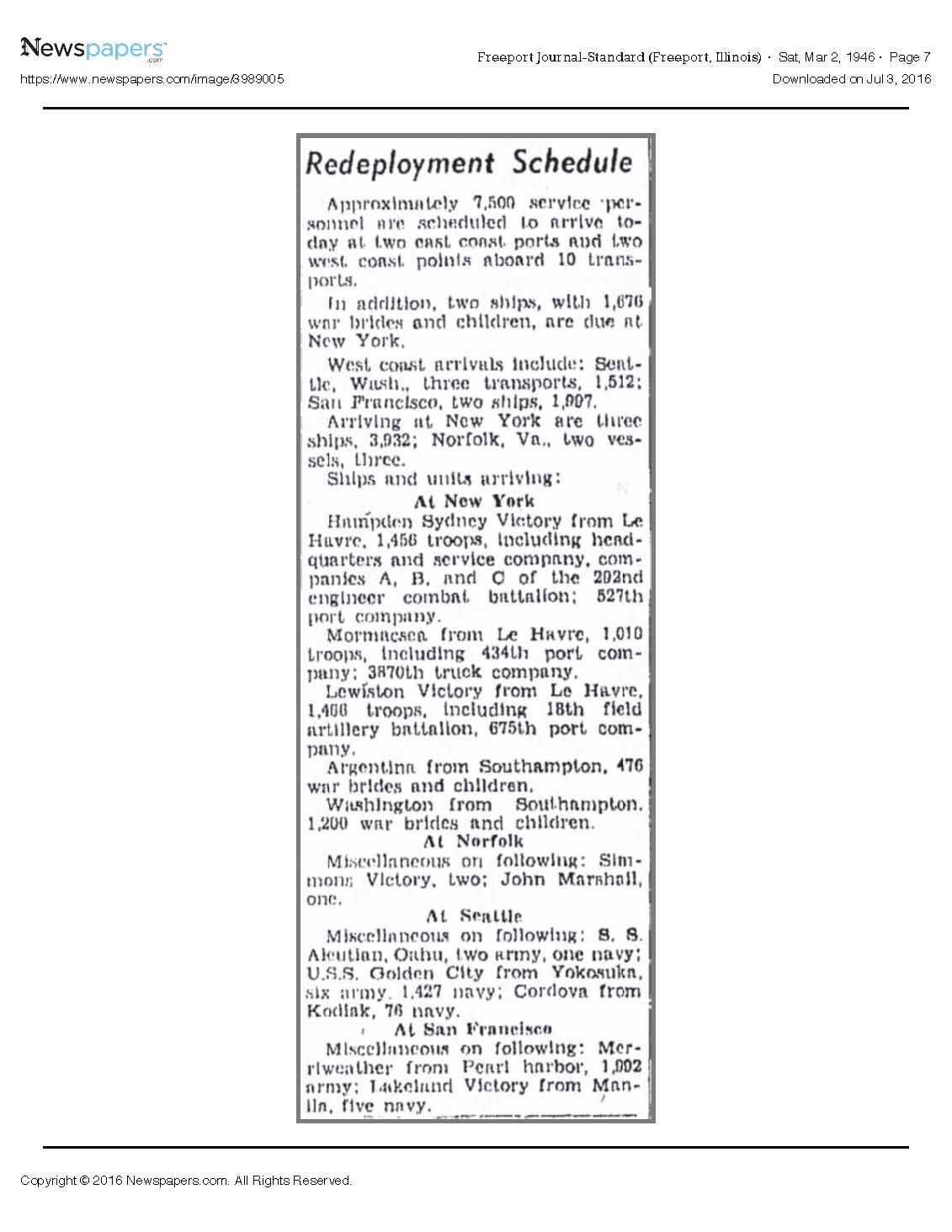
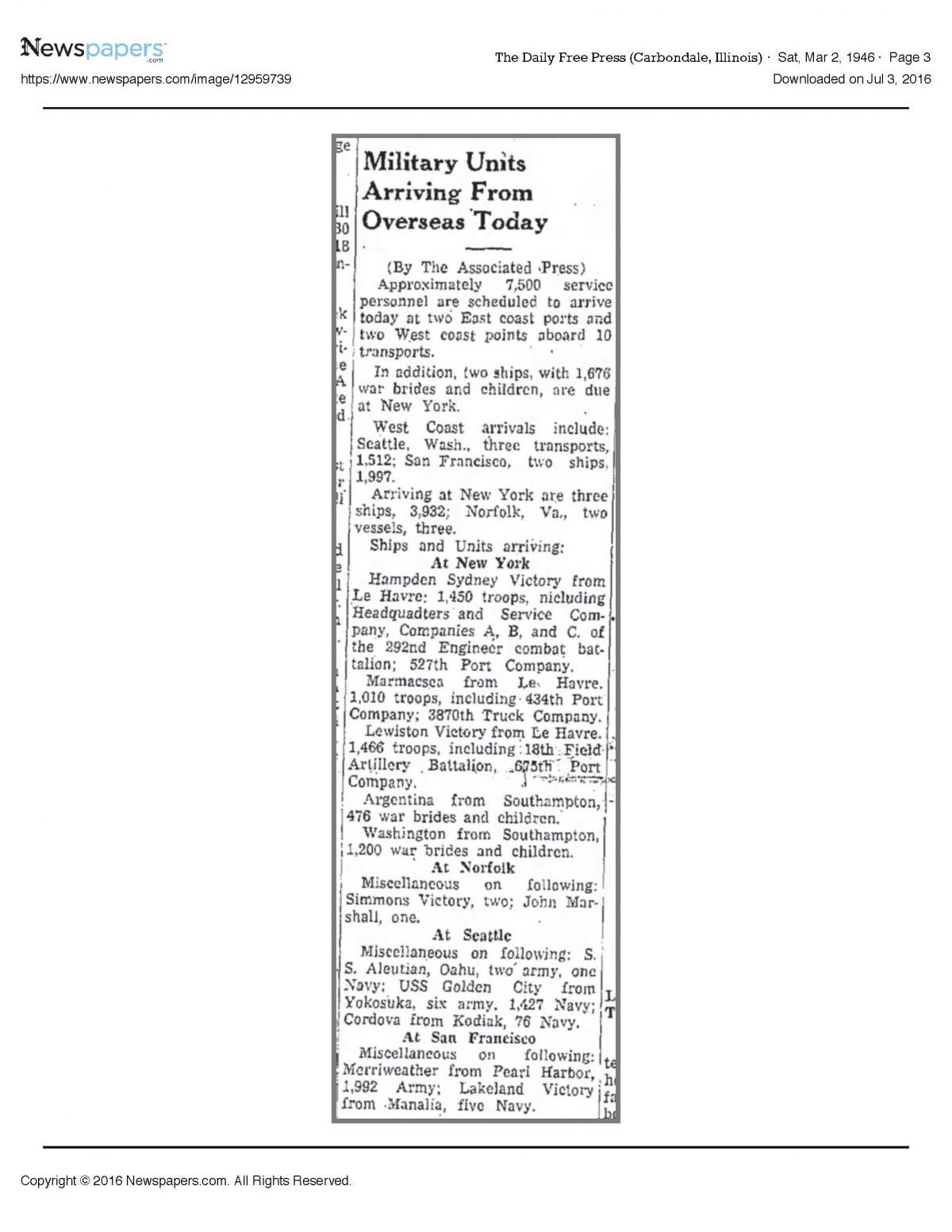
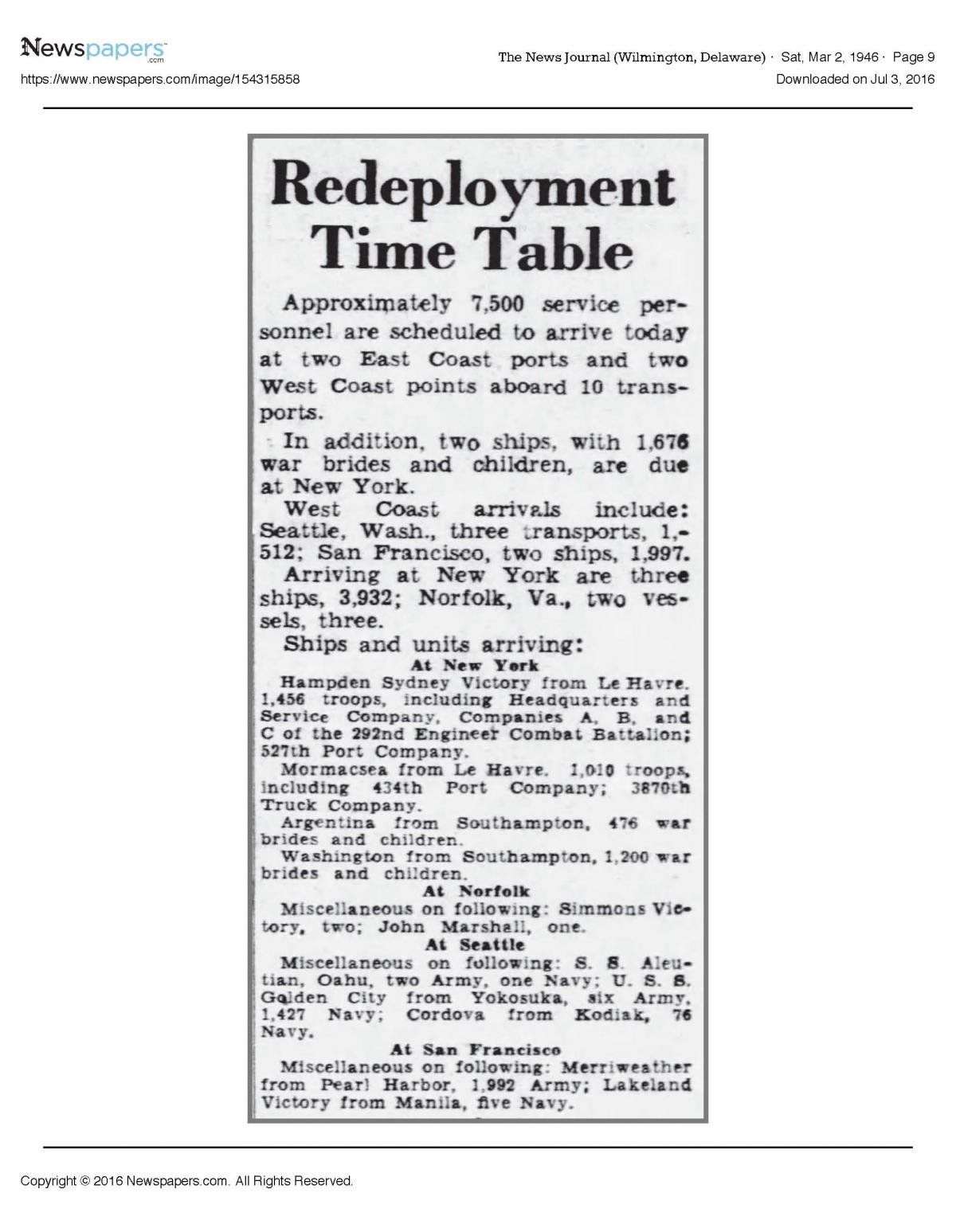
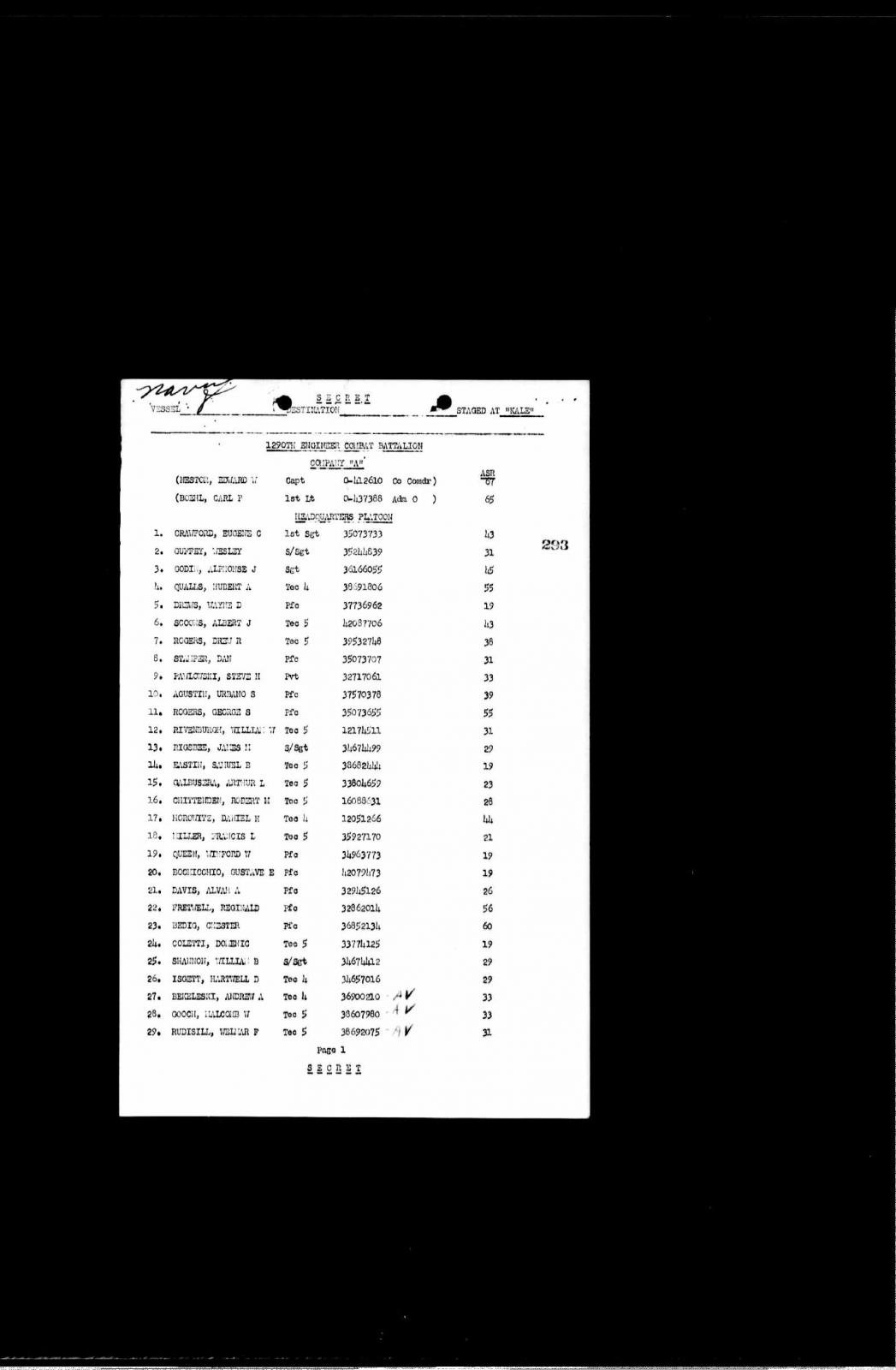
As you stated earlier, newspaper articles of many cities listed this as the ship that the 292nd returned on. So you were spot on with that, my friend. Through Ancestry I accessed New York port records for incoming ships. When carrying troops back to the states, It would seem that some ship's manifests were so detailed that they had unit rosters of those on the ship. Unfortunately, the Hampden Sydney Victory did not get that detailed on this voyage or the other ones that I found. The ship made the following trips and arrived in New York Harbor... from Marseilles on Nov 29 and Dec 30, 1945 and Jan 30 and Mar 2,1946. It also arrived from Bremerhaven on Apr 1, 1946. I attached a couple of additional paper clippings announcing the ships arrival with the 292nd. I also attached a roster from A Company 1290th Engineer Combat Battalion that had a former member from the original roster of the 292nd, Hartwell D. Isget SN 34 657 016 who had apparently previously transferred and arrived in New York Harbor on his way home on Aug 24, 1945 aboard the General J. C. Breckinridge. Just an example of what we, unfortunately, did not get.
Gary
Gary L. Gates
Proud Grandson of Randall Gates
Mechanic, A and H&S Companies, 292nd Engineer Combat Battalion, 1149th Engineer Combat Group
Gary,
No, a gentleman on the ww2f.com forum made that for me. He did a number these for members on that forum, but stopped taking requests for them after awhile, possibly receiving too many. One of these days I'm going to try and figure out how to make it larger so it can be more easily read, I really like it too.
Randy
I think I'll take a crack at it.
Gary L. Gates
Proud Grandson of Randall Gates
Mechanic, A and H&S Companies, 292nd Engineer Combat Battalion, 1149th Engineer Combat Group
Lisa,
I think I'm following what your trying to say, that the men in white are "out of uniform" or at a different level of dress than the all rest. If all the other soldiers were in their Class A (formal) uniforms, your observation would be absolutely correct, the men in white would be in a lower state of dress. I do not believe that is the case here, the Khaki (semi-formal) uniform is in between the everyday fatigues and the formal dress Class A uniform. You are correct that medics don't wear white, they wear the same uniform as everyone else. They do wear the white arm bands with the red cross during field exercises or in the combat zone to display their position. The men in white are not wearing any officers insignia, which pretty much rules them out as being doctors or dentists, such men would be officers. Officers would not be seen without wearing their rank (with the possible exception being in the combat zone, as to not make an inviting target for an enemy sniper). These men in white are privates, which I think helps to make the KP theory. In the end the answer could be something altogether different than the KP or the medical personnel ideas, something we are not thinking of. Perhaps if one of these men in white could be positively identified it might provide the clue that answers the mystery.
Randy
You know I was just thinking (and that's kind of scary )... maybe Marion can chime in on the question of the mystery men in white?
Gary
Gary L. Gates
Proud Grandson of Randall Gates
Mechanic, A and H&S Companies, 292nd Engineer Combat Battalion, 1149th Engineer Combat Group

Here is some information I found about white uniforms for the Army.
Army White Uniform[edit]
One of the Army's Dress Uniforms, the Army White Uniform,[11] was the army's equivalent to the dress white uniform worn by officers in the U.S. Navy, but unlike the navy, which mandates the owning and wearing of the white uniform throughout the summer months (year round in tropical locations) by all ranks (E-1 to O-10), the Army white uniform was an optional uniform, and was only required to be purchased by officers and sergeants major assigned to posts in the tropics and the southern United States. The Army white service uniform was phased out in 2014.

The Dress White uniform worn by General Sam S. Walker
Introduced in 1902 as a summer undress uniform, its wearing, along with the dress and undress blue, was suspended during World War I and was reintroduced in its present form, along with the modern-day dress blue uniform, in 1938.[12] In its original (1902) form the white uniform included a standing collar and white flat braid trimming the coat edges.[13] The 1938 model substituted a white coat without braid and with an open-fronted peak lapel worn with a white shirt and black tie.
With the impending hostilities of World War II, production of both the blue and white dress uniforms were suspended, but the Army white uniform itself served as a model for the Army winter service uniform, which was introduced in 1942 (replacing a belted version designed around the Sam Browne Belt) and discontinued in 1968. The shirt and trousers "class B" uniform was replaced with the Army green class "B" uniform in 1985. The post-war belt-less Army Blue Uniform, and the Army green uniform, had earlier replaced the World War II "Pinks & Greens" and pattern 1942 service coat or "Eisenhower jacket" uniforms in 1956.
Like the Army green uniform, the Army white uniform featured a main jacket with four buttons, worn with matching white trousers and service cap, but unlike the Army green uniform, no unit patches, specialty tabs, or the black beret were worn. Officers wore their silver or gold-colored rank insignia pinned onto the shoulder epaulets, while enlisted personnel wore gold-on-white rank insignia and service stripes on both sleeves as that on the Army Blue Uniform. A white dress shirt and either a black bow tie or four-in-hand necktie, for formal and semi-formal functions, were worn.
Ken Burger
Proud Grandson of Tony Pagoria
Plumber, IX Army, 292nd Engineer Combat Battalion, 1149th Engineer Combat Group, 669th Engineer Topographical Company (Corps)
Here is some information I found about white uniforms for the Army.
Army White Uniform[edit]
One of the Army's Dress Uniforms, the Army White Uniform,[11] was the army's equivalent to the dress white uniform worn by officers in the U.S. Navy, but unlike the navy, which mandates the owning and wearing of the white uniform throughout the summer months (year round in tropical locations) by all ranks (E-1 to O-10), the Army white uniform was an optional uniform, and was only required to be purchased by officers and sergeants major assigned to posts in the tropics and the southern United States. The Army white service uniform was phased out in 2014.

The Dress White uniform worn by General Sam S. Walker
Introduced in 1902 as a summer undress uniform, its wearing, along with the dress and undress blue, was suspended during World War I and was reintroduced in its present form, along with the modern-day dress blue uniform, in 1938.[12] In its original (1902) form the white uniform included a standing collar and white flat braid trimming the coat edges.[13] The 1938 model substituted a white coat without braid and with an open-fronted peak lapel worn with a white shirt and black tie.
With the impending hostilities of World War II, production of both the blue and white dress uniforms were suspended, but the Army white uniform itself served as a model for the Army winter service uniform, which was introduced in 1942 (replacing a belted version designed around the Sam Browne Belt) and discontinued in 1968. The shirt and trousers "class B" uniform was replaced with the Army green class "B" uniform in 1985. The post-war belt-less Army Blue Uniform, and the Army green uniform, had earlier replaced the World War II "Pinks & Greens" and pattern 1942 service coat or "Eisenhower jacket" uniforms in 1956.
Like the Army green uniform, the Army white uniform featured a main jacket with four buttons, worn with matching white trousers and service cap, but unlike the Army green uniform, no unit patches, specialty tabs, or the black beret were worn. Officers wore their silver or gold-colored rank insignia pinned onto the shoulder epaulets, while enlisted personnel wore gold-on-white rank insignia and service stripes on both sleeves as that on the Army Blue Uniform. A white dress shirt and either a black bow tie or four-in-hand necktie, for formal and semi-formal functions, were worn.
It's definitely an interesting dilemma. When it comes to the medical detachment, I can find no information on the members having any kind of white uniform and it would seem that they wore was pretty much what other members of the unit wore. Here's an informative page about WW2 Hospitals and medical personnel:
The jackets that they wear seem more like lab or work coats and they are not wearing ties as all others are. The trousers seem to be white (although that could be from over exposure due to the white shirts) and the headgear seems to be the same as the other soldiers. It seems as though they are wearing some kind of work uniform so could this be a KP uniform or maybe an Orderly uniform for a hospital? Questions, questions...
Gary
Gary L. Gates
Proud Grandson of Randall Gates
Mechanic, A and H&S Companies, 292nd Engineer Combat Battalion, 1149th Engineer Combat Group

Gary,
Nice job! Here is a picture of Stephen Long that Ralph had sent me sometime ago. I know you don't see much of his face because of the pistol. I was thinking Ralph had another picture of him, maybe Ralph will post that if he does.
Good observations about the address book. I looked through some old emails and found a couple of scans Ralph had sent me, showing some names and addresses his father had. As you can see there are some of the same names and the same handwriting.
1-7-2013 6;29;36 PM.jpg
1-7-2013 6;26;50 PM.jpg
Have a good one Gary.
Randy
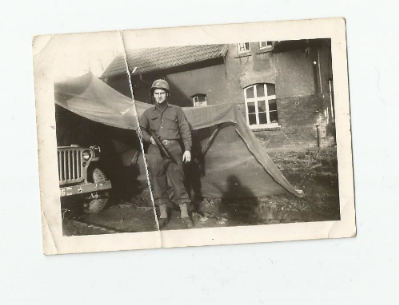
This is the other picture of Stephan Long that I have along with his name and address from the back of the photo. My father said that both of the photo's where Stephan Long but when I compare them now they don't look to me to be the same man. I now think he was mistaken about the man holding the handgun and that the photo with the man holding the Thompson is indeed Stephan Long ,the other maybe not....Ralph

It's definitely an interesting dilemma. When it comes to the medical detachment, I can find no information on the members having any kind of white uniform and it would seem that they wore was pretty much what other members of the unit wore. Here's an informative page about WW2 Hospitals and medical personnel:
The jackets that they wear seem more like lab or work coats and they are not wearing ties as all others are. The trousers seem to be white (although that could be from over exposure due to the white shirts) and the headgear seems to be the same as the other soldiers. It seems as though they are wearing some kind of work uniform so could this be a KP uniform or maybe an Orderly uniform for a hospital? Questions, questions...
Gary
Oct 1969 while in boot camp we did a week of mess duty in the chow hall before going to the rifle range, I was a server on the chow line, I wore for that week a white jacket and white trousers so I think these men were on k p or mess duty. if the army wore white while on that duty at that time. Of course if so I wonder why they didn't change uniform's for the photo Ralph
Gary,
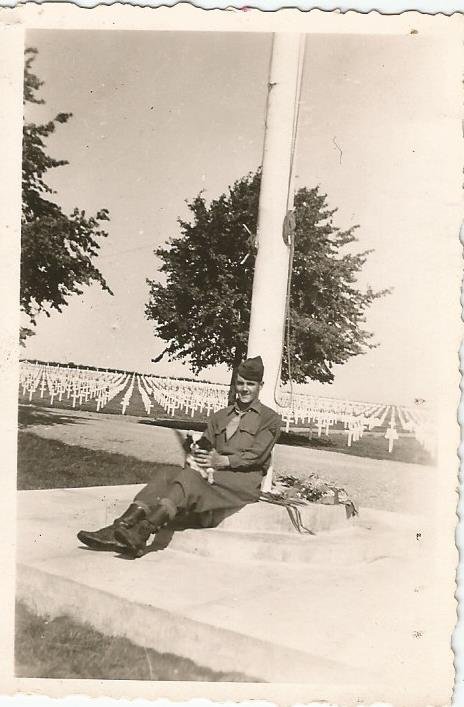
Sorry you missed it buddy but this was mentioned earlier in the thread right after we had received our Company A photos.Ralph had called me and brought it to my attention, I hadn't noticed it at first either. He did not know the name of this soldier, but his dad told him that this guy somehow always managed to come up with a dog anywhere they went. Ralph has several pictures of this guy and he his holding a dog in everyone. Here is one of those, maybe Ralph will post more.
Take care Gary!
Randy
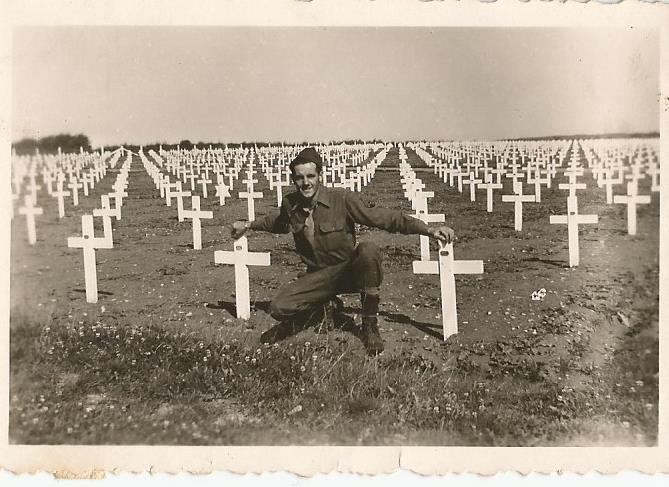
Three photo's of this man, No ideal of his name....Ralph
This is the other picture of Stephan Long that I have along with his name and address from the back of the photo. My father said that both of the photo's where Stephan Long but when I compare them now they don't look to me to be the same man. I now think he was mistaken about the man holding the handgun and that the photo with the man holding the Thompson is indeed Stephan Long ,the other maybe not....Ralph
Ralph, my friend,
Thanks so much for the photo! It puts a face to some of the information that we have and maybe will allow an identification. Any chance to get this uploaded in a higher resolution to assist in this? How about a closeup of the face, also, if possible?
Gary
Gary L. Gates
Proud Grandson of Randall Gates
Mechanic, A and H&S Companies, 292nd Engineer Combat Battalion, 1149th Engineer Combat Group
